

Civic Lecture on Building Incheon as a City of Peace, <2025 Durumi Peace School> Successfully Completed – Viewing Peace on the Korean Peninsula through the Crane, Incheon’s City Bird and a Symbol of Peace –
- 글번호
- 417149
- 작성일
- 2025-12-31
- 수정일
- 2025-12-31
- 작성자
- 홍보과 (032-835-9490)
- 조회수
- 8
2025 Durumi Peace School
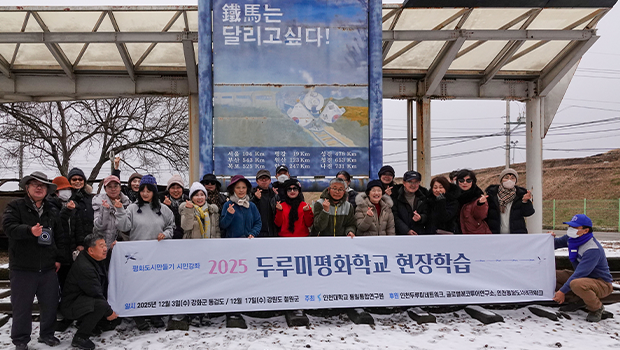
The Institute for Inter-Korean Unification and Integration at Incheon National University (Director: Seong-won Yong) held the civic lecture series titled “2025 Durumi Peace School” from Wednesday, November 26 to Wednesday, December 17 at the Future Hall of Incheon National University, as part of efforts to build Incheon as a city of peace. Following last year’s program, the Durumi Peace School was organized as a civic lecture series consisting of two theoretical lectures and two field study sessions, for a total of four sessions, with more than 100 Incheon citizens participating in total.
The Durumi Peace School is a peace education program for Incheon citizens that seeks pathways toward ecological peace in South and North Korea as well as East Asia through the crane, the city bird of Incheon and a symbol of peace. Reflecting Incheon’s geopolitical characteristics as a border region, this lecture series is held annually to help raise awareness of peace and unification between the two Koreas and to contribute to the expansion of public consensus.
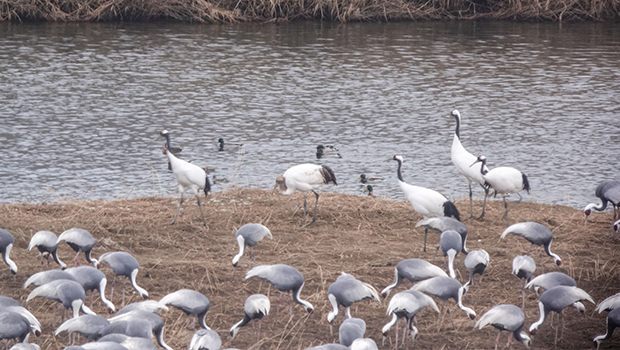
The crane was designated as the symbolic bird of Incheon in 1981, when Incheon was elevated to a directly governed city. In the past, cranes could be seen throughout Incheon’s tidal flats, and ancestors revered them as sacred beings. In particular, cranes serve as a flagship species of the Han River estuary, where tidal flats and wetlands are well developed, with large numbers migrating there each year. In North Korea, regions close to the Han River estuary, such as Kangryong County and Kaesong, also designate cranes as natural monuments and protect them.
Park Soo-taek, a former SBS announcer and environmental journalist who delivered the lectures, explained that cranes inhabit a wide range of areas across East Asia, including Incheon, Paju, Yeoncheon, Cheorwon, Gimpo, Goyang, Suncheon, and Seosan in South Korea; Anbyon in North Korea; the breeding grounds in Qiqihar and the wintering grounds in Yancheng, China; and breeding and wintering areas in Hokkaido, Japan, as well as Izumi in Kagoshima Prefecture, the world’s largest wintering site for hooded and white-naped cranes. Emphasizing that only about 3,500 cranes remain worldwide, making them an endangered species, he stressed the need to seek pathways toward ecological peace by promoting East Asian solidarity and cooperation through crane conservation and habitat preservation.
Kwon Ki-tae, Senior Research Fellow at the Institute for Inter-Korean Unification and Integration, stated, “This lecture series was prepared with the hope that, as part of efforts to strengthen Incheon’s symbolism as a bridgehead and a city of peace on the Korean Peninsula, it would contribute to exploring paths to peace through ecological and environmental cooperation amid the tightly closed political relations between the two Koreas, using the crane, Incheon’s city bird, as a medium.”